Full body CT scans, radiation and what to choose instead
The FDA knows of no evidence that whole body CT screening helps people without symptoms more than it harms them, and a CT of the chest gives as much radiation as more than three years of natural background in the UK. We do not offer whole body CT screening, and use CT to answer a clinical question, from £695, or a low-dose calcium score at £750.
- What it costs
- A GP appointment to decide which scan answers your question is the first step, and a targeted CT is from £695.
- How soon
- A CT report follows within 24 to 48 hours, and a doctor explains it with you.
- How to begin
- Request a GP appointment, and the doctor chooses the test with the least radiation that will answer it.
What a full body CT scan is
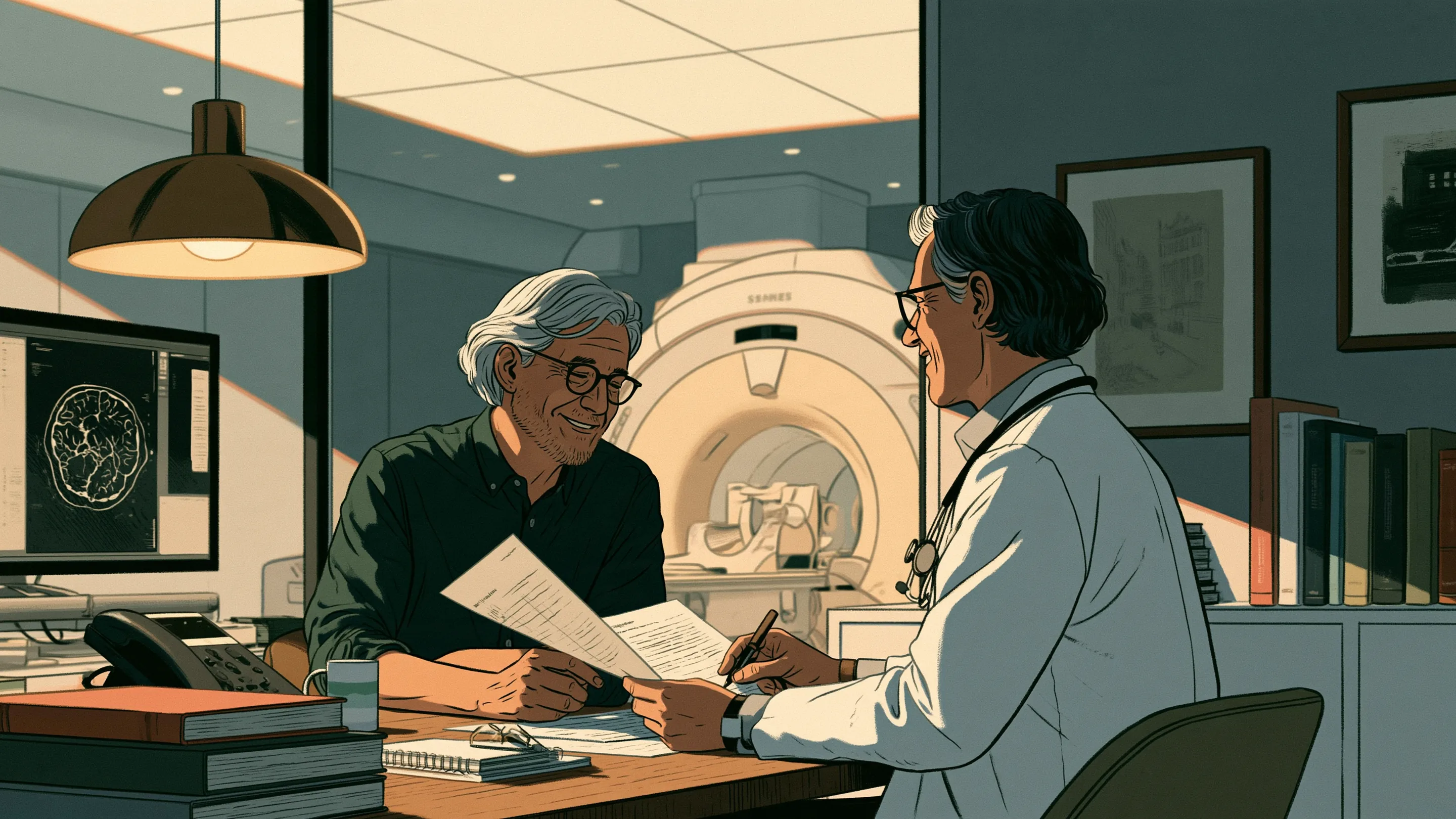
A whole body CT scan uses X-rays to make cross-sectional pictures of the body, usually from the chin to below the hips, and it is sometimes marketed to healthy people as an early warning of cancer or heart disease [1]. CT itself is an invaluable test for people with signs or symptoms of disease, and for planning and checking treatment [1].
The narrower question is whether a person who feels well gains from a scan of the whole body with X-rays, and how much radiation that involves.
What the evidence says about screening
The FDA states that it knows of no scientific evidence that whole body scanning of people without symptoms provides more benefit than harm, and that medical professional societies have not endorsed it [1]. It forbids makers of CT systems to promote them for whole body screening of people without symptoms [1].
The FDA also notes that a scan may not bring the peace of mind people hope for. An abnormal finding may not be serious, a normal finding may be inaccurate, and false leads can prompt further tests that were never needed [1].
How much radiation a CT scan gives
Radiation dose is measured in millisieverts (mSv). People in the UK receive 2.1 mSv a year on average from natural background radiation [2]. A chest X-ray gives 0.02 mSv, about 3 days of background, while a CT of the chest gives 8 mSv, about 3.6 years, and a CT of the abdomen and pelvis gives 10 mSv, about 4.5 years [2].
GOV.UK puts the lifetime added risk of a fatal cancer at about 1 in 2,500 for a chest CT and 1 in 2,000 for an abdomen and pelvis CT, for adults aged 16 to 69 [2]. The FDA describes this risk as very small for a single scan, and notes that the real dose for one person can be two or three times higher or lower than the typical figure [3]. A whole body scan covers several regions at once, so its dose adds up.
A calcium score CT of the heart is a low-dose scan of about 1.7 mSv, comparable to about 6 months of background radiation [4].
Why every scan in the UK must be justified
Under the Ionising Radiation (Medical Exposure) Regulations 2017, every exposure to X-rays must be justified before it happens, by a practitioner who weighs its benefit against its harm for that person [5]. The practitioner must consider whether a technique with less or no ionising radiation could answer the same question, and for a person without symptoms must take account of guidance from medical and scientific bodies [5].
This is why a doctor talks with you before any CT is arranged. A scan with no clinical question behind it is hard to justify, and a scan with a clear question is usually smaller and lower in dose.
What to choose instead
For a detailed look at the body without radiation, MRI is the usual choice, and a full body MRI covers the brain to the pelvis with no X-rays at all [6]. Ultrasound also uses no radiation and suits many questions about the abdomen, pelvis and blood vessels [6].
For heart risk, a calcium score is a targeted, low-dose test that can help when your risk is uncertain or in the middle range [7]. It is not recommended for people already known to be at high risk or who have had a heart attack, a stent or bypass surgery [7].
Who should avoid CT unless it is needed
If you are pregnant or could be, tell the doctor before any X-ray or CT, because ultrasound or MRI is preferred where it can answer the question [8]. Children are more sensitive to radiation, and a CT for a child is planned with particular care [3]. If you have had several CT scans recently, bring the dates so the doctor can count them in.
If you have chest pain, sudden breathlessness, severe bleeding or signs of a stroke, call 999 in the UK, or the local emergency number elsewhere. A scan is never the first step in an emergency.
Questions to ask your doctor
These help you agree the right test before any radiation is involved.
- What question will this scan answer?
- Is there a test without radiation that would answer it?
- What dose will this scan give me?
- What happens if it finds something unexpected?
How The Wellness can help
We do not offer whole body CT screening. A GP sees you first, often the same day, and chooses the test that answers your question with the least radiation. When CT is the right test, it is carried out on a 128-slice scanner with low-dose protocols as standard, from £695, and a calcium score is £750, each reported within 24 to 48 hours [6].
If you want a detailed baseline without radiation, a full body MRI is available on our imaging page, with a physician consultation to discuss the findings included. Our clinics are on Baker Street in Marylebone and Eccleston Street in Belgravia, and every doctor is GMC registered.
Questions
Is a full body CT scan safe?
The radiation risk of one scan is very small, but the FDA knows of no evidence that whole body CT screening helps people without symptoms more than it harms them [1] [3].
How much radiation is in a CT scan?
A chest CT gives about 8 mSv, roughly 3.6 years of natural background radiation in the UK, and an abdomen and pelvis CT about 10 mSv [2].
Can I have a full body CT scan in London?
Some clinics offer one, but we do not. We use CT to answer a specific clinical question, and offer a full body MRI, which uses no radiation, for a detailed baseline [6].
Sources
- [1]US Food and Drug Administration, Full-body CT scans, what you need to know, read 14 October 2026
- [2]GOV.UK (UK Health Security Agency), Patient dose information guidance, updated 28 September 2026, read 14 October 2026
- [3]US Food and Drug Administration, What are the radiation risks from CT, read 14 October 2026
- [4]RadiologyInfo.org (ACR and RSNA), Radiation dose in X-ray and CT exams, read 14 October 2026
- [5]Department of Health and Social Care, Guidance to the Ionising Radiation (Medical Exposure) Regulations 2017, updated 4 September 2024, read 14 October 2026
- [6]The Wellness, medical imaging, read 14 October 2026
- [7]Mayo Clinic, Coronary calcium scan, read 14 October 2026
- [8]RadiologyInfo.org (ACR and RSNA), MRI safety during pregnancy, read 14 October 2026
Written and reviewed by the clinical team at The Wellness. Last reviewed 15 October 2026. This page is general information and not a substitute for advice from your own doctor.